CAD by conversation
A pool-light collar, a rod-holder gift, a tri-color pun sign, nine sizes of hole plug, and a drawer of custom Gridfinity bins -- a month of household parts that came out of conversations with Claude writing OpenSCAD, with the failure that taught each one written down.
The white ASA collar that snaps around my pool’s floating light began as a pencil sketch and exactly two measurements: 110 millimeters across the light body, 25 millimeters up the brim. Its whole job is width — it makes the light too wide to get pulled into the skimmer throat, a part nobody sells. I never opened a CAD application. I described what I wanted, Claude wrote OpenSCAD, a render showed us both what the words had actually said, and on June 21st the first print snapped onto the light and held.
That was week one. Three weeks later the same loop had produced a drawer of custom Gridfinity bins, a batch plate of nine hole plugs, a rod-holder insert for a fishing buddy, and a tri-color joke sign, and it had picked up a discipline I didn’t expect to need.
#The geometry is text
OpenSCAD is CAD as source code: a part is a program, and the program compiles
to a solid. 1 No sketching, no mouse, no feature tree — a
cylinder() here, a difference() there, variables for every dimension that
might change.
For an AI pair, that property is the entire ballgame. A language model has no eyes on a B-rep surface and no cursor to drag a fillet with. What it has is fluency in structured text: emitting it, revising it, holding its rules in its head. Code-CAD converts “model this” into a text-transformation problem. And the side effects are the point: the part is parametric by default, diffable in git, and re-generatable for as long as the library holds still. One dimension on the collar is still a guess — the skimmer throat is modeled at 225 millimeters because I haven’t fished the real number out of the deck yet — and when I do, the fix is editing one variable and reprinting, not remodeling.
The geometry was always text, of course; OpenSCAD predates the AI that now writes it by fifteen years. What changed is who writes it. The unit of iteration used to be my evening with a manual, and now it’s a sentence. The heavy lifting rides on BOSL2, the community geometry library that gives OpenSCAD real fillets, edge rounding, and attachment semantics. 2 Claude reaches for library constructs I wouldn’t have found in a week of docs, and it also invents plausible-looking arguments that don’t exist. Which is why the whole workflow hangs on a loop.
For caps, plugs, rings, shims, brackets, and bins, code-CAD driven by conversation is now the fastest tool I own — a claim I would not have believed in May.
#The loop
The workflow is a conversation with a compiler in the middle:
A one-line ask goes to Claude, which edits the OpenSCAD source. OpenSCAD renders the part to a PNG. I eyeball the render and sometimes slice it. If it is not right yet, the loop returns to another one-line ask; when it holds up, the part prints in ASA.
The collar went through five shapes in one evening, every step a single ask.
A solid two-half clamp bolted together. Then a top-and-bottom clamshell that
snapped instead of bolting. Then the solid cup opened into a spoked frame.
Then fillets and brim windows. Then the frame’s posts re-rooted so each arm
anchors into the hub wall. None of them was a spec. Claude edits the source, renders it headless
(openscad -o check.png), and reads the picture back itself; I look at the
same image with different questions. The artifact under all of it stays
plain text — these lines are verbatim from the model file:
/* [Light measurements] */
// Light outer diameter (mm)
light_d = 110;  // [40:1:200]
// Brim height - the vertical wall that gets captured (mm)
brim_h  = 25;   // [8:1:60]

/* [Skimmer / width] */
// Collar outer diameter - MUST exceed the skimmer throat (mm)
collar_od = 225; // [120:1:260]

part = "bottom"; // [assembled, bottom, lid, both_flat]
One openscad -o cup.stl -D 'part="bottom"' collar.scad later, the cup is
sitting in the slicer.
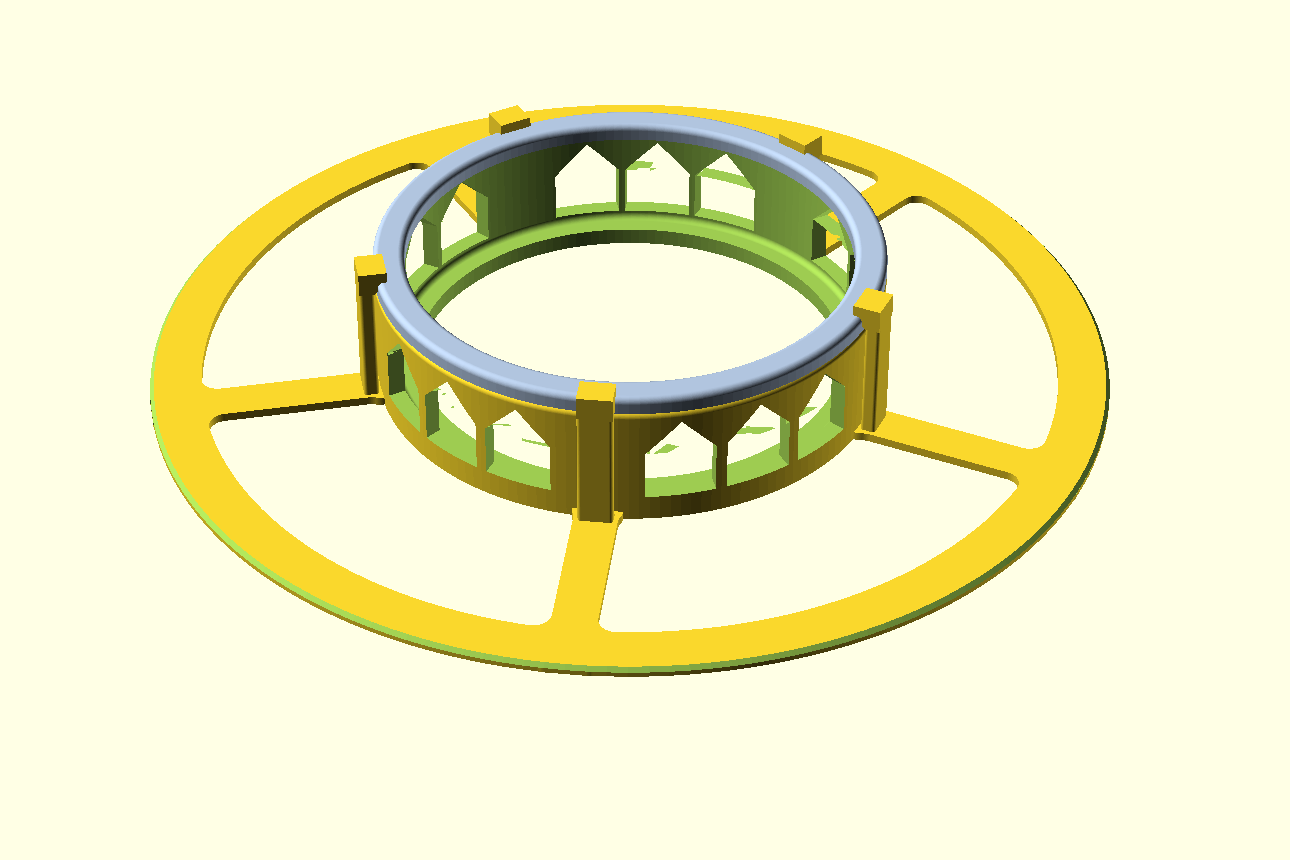
Two constraints I had to state like requirements, because no render would ever surface them: both parts print flat with no supports, and the little gabled windows in the brim are self-supporting at 45 degrees.
A sentence in, a render out. The picture is where the ask meets the object, and it settles the argument faster than either of us can talk.
#Compiles clean, fails as an object
Render-and-eyeball exists because the model reliably produces geometry that compiles and still fails as an object. Its recurring failure class is composition: parts that meet but don’t join. The drawer-organizer bins made it a trilogy, three versions in two days, every one of them passing the renders and failing in the slicer.
Version 2.1: the interior corner fillets notched the rolled rim by a
millimeter at each corner, because the rim bead only covered the midline of
the wall. Version 3 was the deep one: visible steps where the finger dips met
the rim. Root cause, the rim was composited from separate segments meeting at
tangent seams — the same “pieces pretending to be a surface” failure, now
load-bearing. The fix that stuck was categorical: rebuild the rim as one
closed 3D path swept in a single BOSL2 path_sweep, dips included, so no
junction exists to fail. The rule went into the project notes as make seams
impossible instead of patching them. Version 3.1 was the epilogue: the new
rounder body left a crescent of foot poking proud at each bottom corner,
fixed by lofting the corner radius from 3.75 up to 6 over the first 11
millimeters of height. Bounding-box checks to a hundredth of a millimeter
proved each rebuild matched the intended envelope — code equivalence, not
print precision.
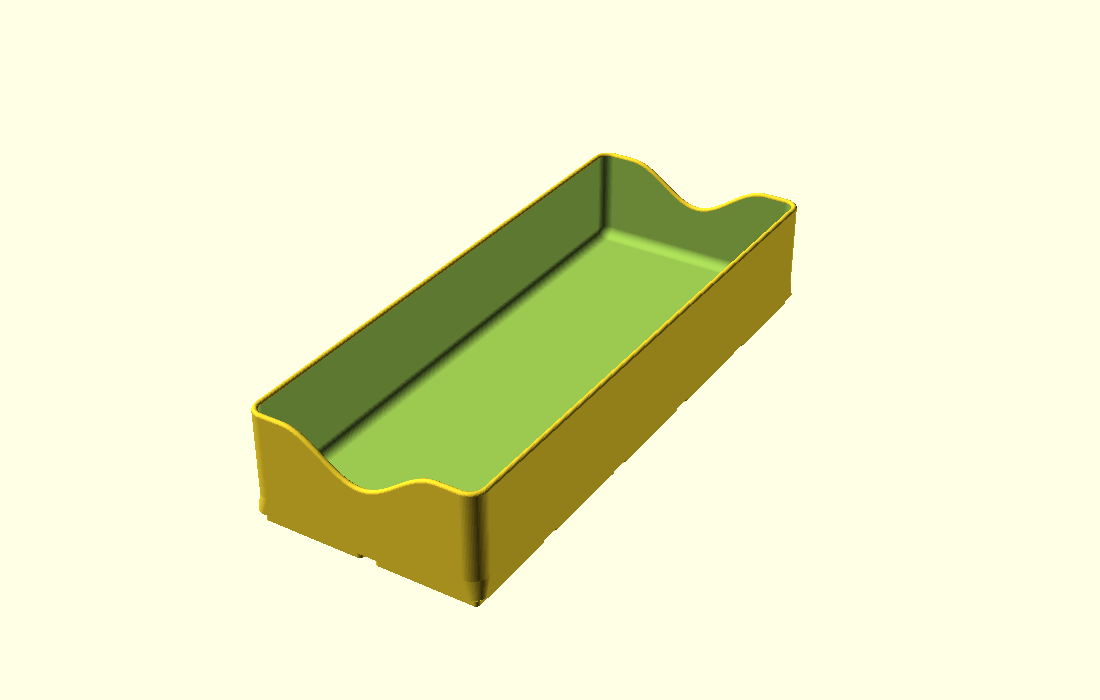
Three catches, zero caught by a render — not because renders are useless (they killed four collar shapes in one evening) but because composition failures hide in exactly the places a pretty picture glosses over. The slicer’s layer preview prices every mistake in grams and hours, shows the step the render forgave, and doesn’t care how nice the code reads. Model proposes, render persuades, slicer decides.
#A month of parts
| Part | The input | Material | Where it stands |
|---|---|---|---|
| Skimmer light collar | hand sketch + 2 measurements | ASA | printed June 21, fits the light; final width waits on one measurement |
| Rod-holder insert | 3 reference photos | flexible filament; stiff ruled out | printed the next day |
| ”BEWARE of DOUG” sign | 1 reference photo of the classic enamel sign | tri-color PLA | print files ready, inlay + raised variants |
| Hole plugs, 9 sizes | calipers on chair + door-frame holes | PLA | nine STLs on one batch plate |
| Silverware drawer kit | tape measure: 337 x 450 x 75 mm | PLA | grid printed and fitted; bins sliced, gated on one fork |
The rod-holder insert — a gift for a fishing buddy — dropped the sketch
entirely: modeled from three reference photos and four parametric inputs, an
Assassin-style tapered cushion that wedges into an oversized boat rod holder.
Its keyhole slot has to flex open to clip over a rigged rod, which drove the
material call (stiff filament cracks at the slot’s neck unless you give up
the snap). And it carries my favorite trick of the batch: the model ships a
part="cutaway" half-section whose only job is letting both of us see the
internal bore and slot in a render — an inspection fixture, living in the
same file as the part.
The sign. A friend named Doug was always going to receive a “BEWARE of DOUG” sign in the style of the classic black-and-red enamel original, and multi-color is where slicer craft starts to matter. The lettering lives in a one-millimeter front skin — about five layers — so the material swaps stay cheap, purge waste dumps into the big black body as infill, and the sign prints face down with the text pre-mirrored so the flush “inlay” face comes off the plate looking screen-printed.

It also surfaced the best gotcha of the month: OpenSCAD’s fast preview mis-colors intersected geometry, so the field flashed red until we forced the full CGAL render. The fast picture lies a little.
The hole plugs replaced a 290-piece assortment of stick-on hole covers whose drawer never once contained the size I needed. The replacement is a parametric generator in the well-worn customizer style: barbed push-plug, domed head, optional retention ribs, and a batch layout that grids out however many you ask for. Nine sizes between 8.5 and 15 millimeters, laid out on one plate, matched to the actual holes in the Adirondack chairs and a sliding-door frame instead of to a kit manufacturer’s guess.
The drawer kit ran the loop at furniture scale. The Gridfinity project already ships a parametric baseplate generator, so the grid itself needed zero modeling — tape-measure numbers in, plates out, split two-by-two for a 256-millimeter bed. An eight-by-ten grid of 42-millimeter units covers 336 by 420; the generator fuses the leftover ~30 millimeters (29 after clearance) onto the rear plates as fit-to-drawer padding, and the assembled set lands within a millimeter of the drawer on both axes. 3 The custom work started only when the bins wanted rolled rims and finger dips the stock generator doesn’t do, which is what produced the trilogy above. The full kit budgets over a kilogram of filament, so the slicer’s grams-and-hours pricing stopped being abstract; the grid went first and doubled as the calibration test, and the bins sit sliced awaiting one over-length fork that decides which column layout prints.
Rules the month wrote into the project notes: search the model libraries before modeling anything (the printer’s own desiccant containers were a download, not a design); no calipers means no measuring, and an unmeasured part waits; material follows exposure, ASA where the Florida sun and pool water get a vote, flexible where a neck has to bend, plain PLA indoors. Everything prints on a Bambu Lab X2D, whose heated chamber is the spec doing quiet work here — it’s what makes ASA a routine print instead of a gamble. And the honest bottleneck is no longer modeling. Two of the five builds sit gated on a number only I can go get, which makes the critical path of the whole workflow me, holding a tape measure.
#The inputs keep getting thinner
Look at the input column again: a sketch, then photos, then a single reference image, then bare numbers off a tape measure. The loop holds as the input thins: three photos or two tape-measure numbers still come back as a shape, and judging the shape is the same job at every thickness.
The month started in FreeCAD: I hand-modeled replacement card-table inserts and a solar-light plate one feature at a time with a mouse. Real parts, fine work — but the skill that compounded was mine alone, locked in my hands. The conversation loop compounds in a file: the collar taught render checking, the bins taught seam discipline, the sign taught color economy, and each rule went into the project notes the next session reads first.
The collar ships with this post: the OpenSCAD source, plus the print-ready cup and lid STLs. Flat, support-free, ASA recommended if it lives outside.
The collar’s first print has been snapping on and off the pool light since June while one last number decides its final width. The sketch and every taste call were mine; the geometry was negotiated. I still can’t sculpt a solid with a mouse. It turns out the scarce skill was never the modeling — it was knowing what right looks like when it renders, and being willing to say “again” until it does. 4
Notes
- OpenSCAD, the programmers' solid 3D CAD modeller. Constructive solid geometry, plain-text source, deterministic output. Same trick, other kernels: build123d and CadQuery drive B-rep engines from Python, and the argument here travels to them. ↩
- BOSL2, the Belfry OpenSCAD Library v2: fillets, rounding, attachments, sweeps, and most of what stock OpenSCAD makes you earn by hand. If you try this workflow, hand the model BOSL2 from the first prompt; the difference in output quality is not subtle. For the record, this ran through Claude Code on the Opus-class model current in June 2026 -- the loop, not the model version, is the part that transfers. ↩
- Gridfinity is Zack Freedman's open modular storage standard; the gridfinity-rebuilt-openscad generator makes baseplates and stock bins a parameters problem. Designing custom bins on the 42-millimeter standard instead of as a one-off tray means every future re-organization is just lifting bins. ↩
- A companion post, The tasks AI makes worth doing, argues that AI moves the line on which tasks clear the effort bar. This post is the physical-world case: the custom parts that were never worth a CAD license and an evening of tutorials are suddenly worth a conversation. ↩